
If you’ve lived in San Diego County long enough, you’ve noticed something: your allergies don’t really have an off-season. Dust mites stay active from October through March. Tree pollen from oak, mulberry, and olive trees peaks from March through May. Then the Santa Ana winds show up and push desert particulates straight through your windows before you’ve even finished your coffee. For homeowners across San Diego County, a deep spring clean isn’t a cultural ritual — it’s closer to maintenance. This checklist covers every major room, the tasks that actually matter, and a few honest notes on what’s worth outsourcing.
Living Room Deep Cleaning Checklist: What Most People Miss
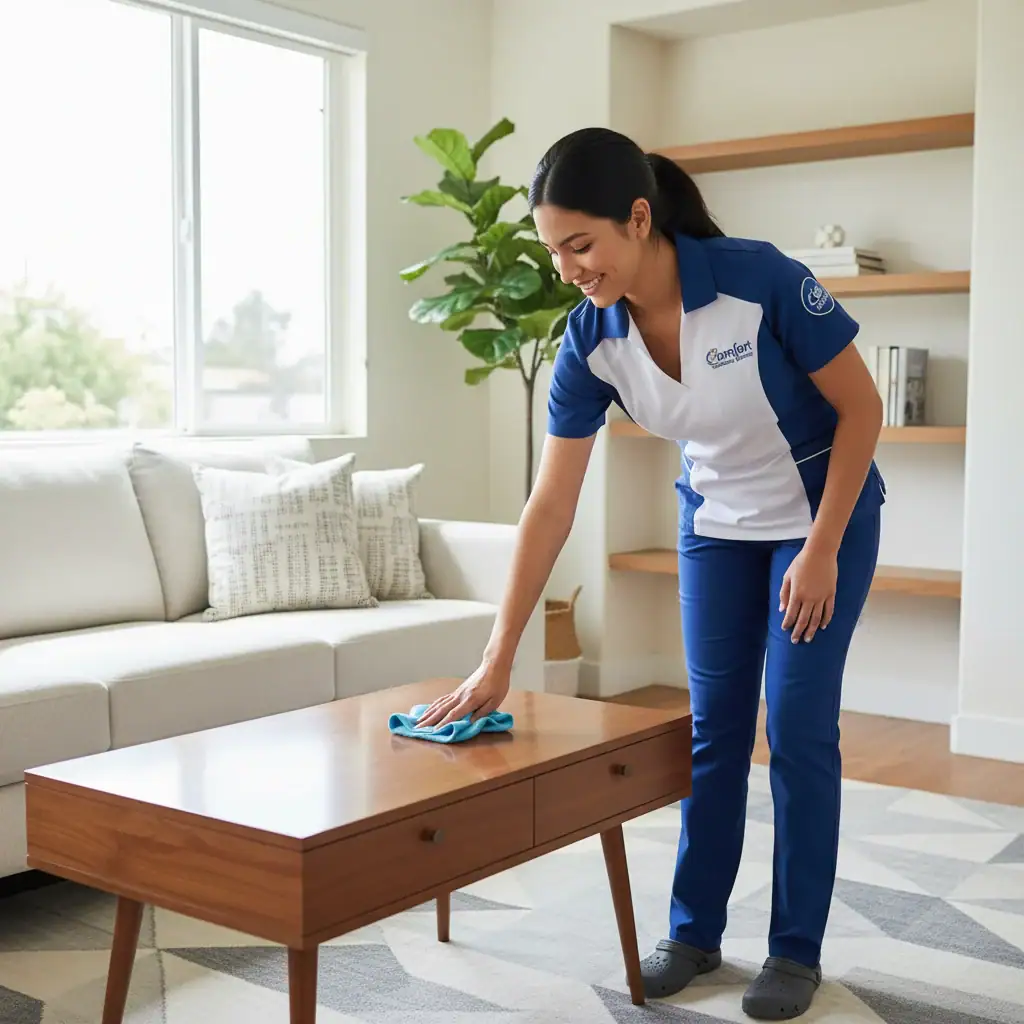
The living room gets used constantly but deep-cleaned rarely. Regular vacuuming handles the surface, but a genuine deep clean means getting into the places that accumulate buildup over months — the kind that affects air quality, not just appearances.
Start with the ceiling fan blades, which collect a surprising amount of dust and release it every time the fan turns on. Then work down: wipe down baseboards, clean window sills and tracks, and pull furniture away from the walls to vacuum underneath. Upholstered cushions should come off the couch — vacuum underneath them, not just the surface. Wipe down remote controls, light switches, and any electronics. If you have an area rug, it needs more than a pass with a vacuum; beating it out or having it professionally cleaned is a different level of clean entirely.
Full House Deep Cleaning Checklist: The Rooms That Always Get Skipped
There’s a version of spring cleaning that most people do — wipe the counters, mop the kitchen floor, maybe scrub the toilet — and then there’s what a full house deep clean actually involves. The gap between the two is where the real buildup lives.
In the kitchen, it’s the inside of the oven, the refrigerator coils, the range hood filter, and the space behind the fridge that almost never gets touched. In the bathroom, it’s the grout lines, the caulking around the tub, the underside of the toilet rim, and the cabinet under the sink where moisture tends to collect. In the bedroom, it’s under the bed, inside the closet (shelves, not just the floor), and the mattress itself — which should be vacuumed and, ideally, flipped or rotated.
Hallways and entryways are easy to overlook entirely. But in San Diego County, your entryway is where beach sand, canyon trail dirt, and coastal particulates get tracked in daily. That’s not just a cosmetic issue — silica sand from San Diego County beaches is hard enough to micro-scratch hardwood floors if it’s not properly vacuumed before mopping. Baseboards throughout the house, door frames, and the tops of door casings are the other chronic blind spots. They gather dust steadily and get skipped in regular cleaning because they’re not eye-level.
Windows deserve their own mention. Cleaning the glass is one thing, but the tracks — the grooves the window slides in — collect dead insects, sand, and grime that most people never address. In neighborhoods near the coast like Pacific Beach, Ocean Beach, or Coronado, salt air accelerates buildup on window frames and sills. A cotton swab or a small brush is often the only tool that actually gets into the tracks.
The honest reality is that a full house deep clean takes most people significantly longer than they expect. A thorough pass through a two-bedroom home, done properly, is realistically a six-to-eight-hour project. That’s before you account for laundry, decluttering, or anything that needs to be moved to access the areas behind it.
Home Office Deep Cleaning Checklist: Why San Diego County’s Remote Workers Need This More Than They Think
The home office is the room that spring cleaning guides almost always treat as an afterthought — a single line item at the bottom of a list. But if you work from home, or even use a desk space occasionally, it’s one of the highest-contact surfaces in your house and one of the least frequently cleaned.
Start with the desk surface itself, but don’t stop there. Keyboards harbor more bacteria per square inch than most bathroom surfaces — a fact that’s unpleasant but worth knowing. Use compressed air to clear debris from between the keys, then wipe them down. The monitor screen, the mouse, and any shared peripherals all need attention. Cables and cords collect dust along the floor and behind furniture; wiping them down and organizing them makes a real difference in how the space feels.
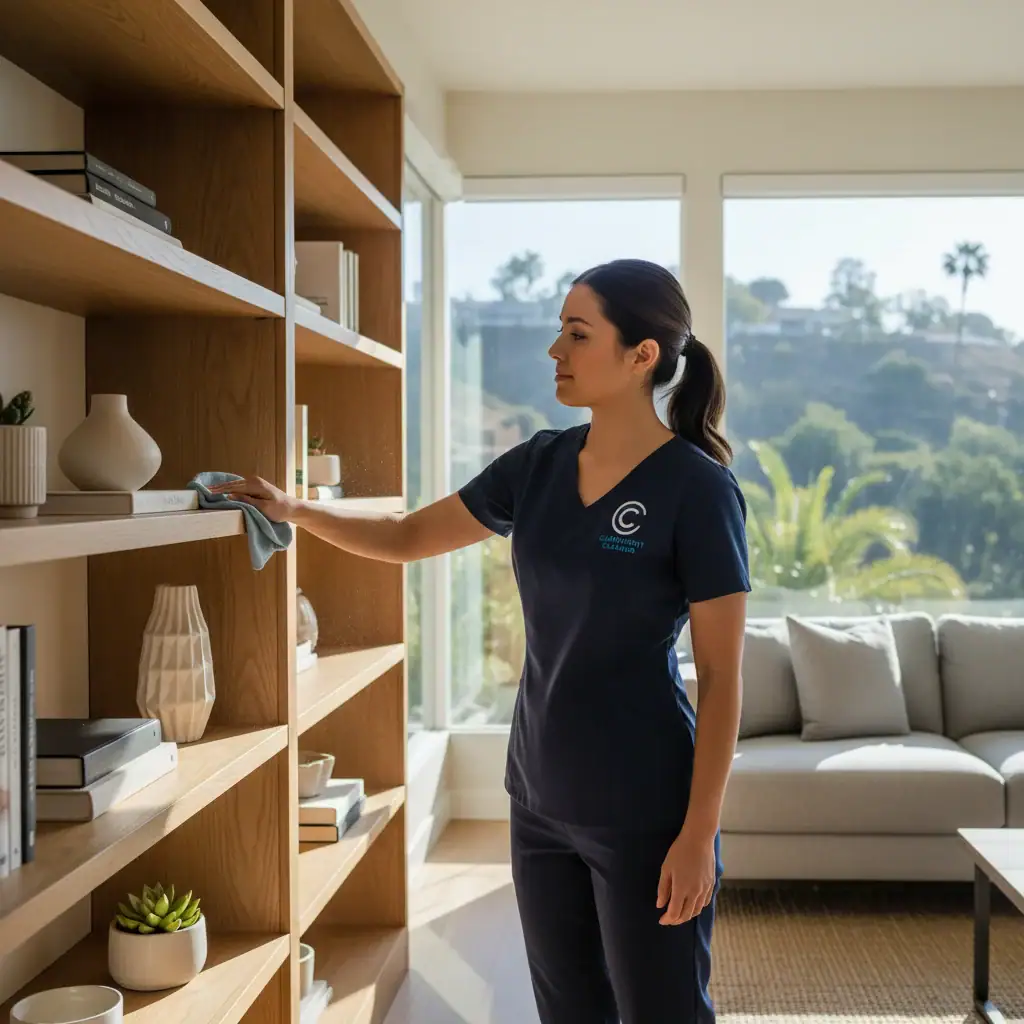
Bookshelves and filing areas are their own project. Dust doesn’t just settle on the tops of books — it accumulates on the spines, on the shelves themselves, and on anything stored horizontally. If you have stacks of paper or files that haven’t been touched since last year, spring is the right time to go through them. Clutter in a workspace isn’t just visual noise — research from the Journal of Environmental Psychology found that clutter measurably increases cortisol levels, the body’s primary stress hormone. Clearing it produces a quantifiable reduction in that stress response.
The floor in a home office tends to be neglected because furniture covers most of it. Pull the chair out, move the desk if you can, and vacuum the full floor — including along the baseboards. Chair upholstery, if fabric, should be vacuumed as well. And if your office has a window, clean the sill and the track. In San Diego County, even inland neighborhoods like Mission Valley or Clairemont accumulate fine particulates from canyon vegetation and seasonal winds. A clean window sill isn’t just aesthetic — it’s one fewer surface contributing to indoor allergen levels.
What an Allergen Cleaning Service Actually Does
An allergen cleaning service is a deep cleaning approach specifically focused on removing the particles that trigger allergic reactions — dust mites, pet dander, mold spores, pollen, and fine particulates — rather than just making surfaces look clean.
In practice, that means a few things that a standard cleaning doesn’t cover. HEPA-grade vacuuming is central to it — standard vacuum filters release fine particles back into the air, while HEPA filters capture 99.97% of particles down to 0.3 microns, including dust mite debris and pollen. Soft surfaces get more attention than hard ones, because upholstery, mattresses, and area rugs retain allergens at a much higher rate than tile or hardwood. Bedding should be washed in hot water — 130°F or above — which removes the vast majority of dust mite matter. Air vents and returns, which circulate allergens throughout the entire home, are another focus area that standard cleaning typically skips.
For San Diego County homeowners specifically, allergen cleaning carries more weight than it does in most U.S. cities. San Diego County has the most reported allergy cases of any region in Southern California. The combination of year-round dust mite activity, spring tree pollen from oak, cedar, mulberry, and olive trees, and Santa Ana wind events that pull pollen and particulates in from Arizona and Nevada means there’s genuinely no month when indoor allergen levels are naturally low. Canyon-adjacent neighborhoods like Kensington, Mission Hills, and Clairemont deal with particularly high pollen loads from surrounding native and non-native vegetation.
At Comforts Cleaning Services, our deep cleaning service addresses these surfaces systematically — not just the visible ones. We use only non-toxic, biodegradable, eco-friendly products throughout, which matters in homes with kids and pets who are low to the ground and in close contact with the surfaces we clean.
How Often Should You Deep Clean Your Home in San Diego County?
The standard answer is once or twice a year, and for most U.S. cities, that’s reasonable. San Diego County is a different situation. The combination of year-round allergen activity, an active outdoor lifestyle that tracks in beach sand, canyon dirt, and coastal particulates, and a mild climate that keeps homes open and ventilated for most of the year means buildup accumulates faster here than in climates with true winters.
A practical approach for most San Diego County households is a thorough deep clean in spring — March or April, before tree pollen peaks and while you’re still motivated by the seasonal reset — and a second pass in fall, after wildfire smoke season and before dust mite activity climbs again in October. For homes with pets, young children, or residents with allergies or asthma, a deeper cleaning rhythm — quarterly, or at minimum after any significant Santa Ana wind event — is genuinely worth the effort.
Regular professional cleaning between deep cleans makes the deep cleans less intensive. When surfaces are maintained consistently, the seasonal reset focuses on the areas that standard cleaning doesn’t reach — inside appliances, grout, baseboards, upholstery — rather than having to address months of accumulated buildup on top of everything else.
The question of whether to DIY the deep clean or hire a professional team usually comes down to two things: time and the areas that consistently get skipped. Most people can handle the visible surfaces. The baseboards, oven interior, refrigerator coils, window tracks, grout, and upholstery are the tasks that get pushed to “next time” year after year — and those are exactly the areas where a professional team makes the most difference. Our team at Comforts Cleaning Services brings all supplies and equipment, uses eco-friendly products throughout, and operates with a 24-hour satisfaction guarantee, so if anything isn’t right, we come back and correct it at no charge.
Pricing for our deep cleaning service starts at $55 per hour per cleaner, with a three-hour minimum. Recurring clients receive discounted rates — $50 per hour for monthly service, $45 per hour for weekly or bi-weekly visits. There are no hidden fees, and we’ll give you a clear picture of what to expect before we start.
Ready to Actually Finish the Deep Spring Clean This Year?
The checklist is useful. But the part most people struggle with isn’t knowing what to clean — it’s the scope of it, the time it takes, and the spots that get skipped every single year. For San Diego County homeowners dealing with canyon pollen, coastal salt air, marine layer humidity, and Santa Ana dust events, a genuine deep spring clean is less of a tradition and more of a health decision.
If you want to handle it yourself, this guide gives you a solid starting point. Go room by room, work top to bottom, and don’t skip the baseboards, window tracks, or anything that requires moving furniture. If you’d rather hand it off — or just tackle the rooms that matter most and let professionals handle the rest — Comforts Cleaning Services serves 20-plus neighborhoods across San Diego County, from La Jolla and Coronado to Chula Vista, Clairemont, and El Cajon. Reach out to get a quote, and we can usually get you on the schedule within a week.