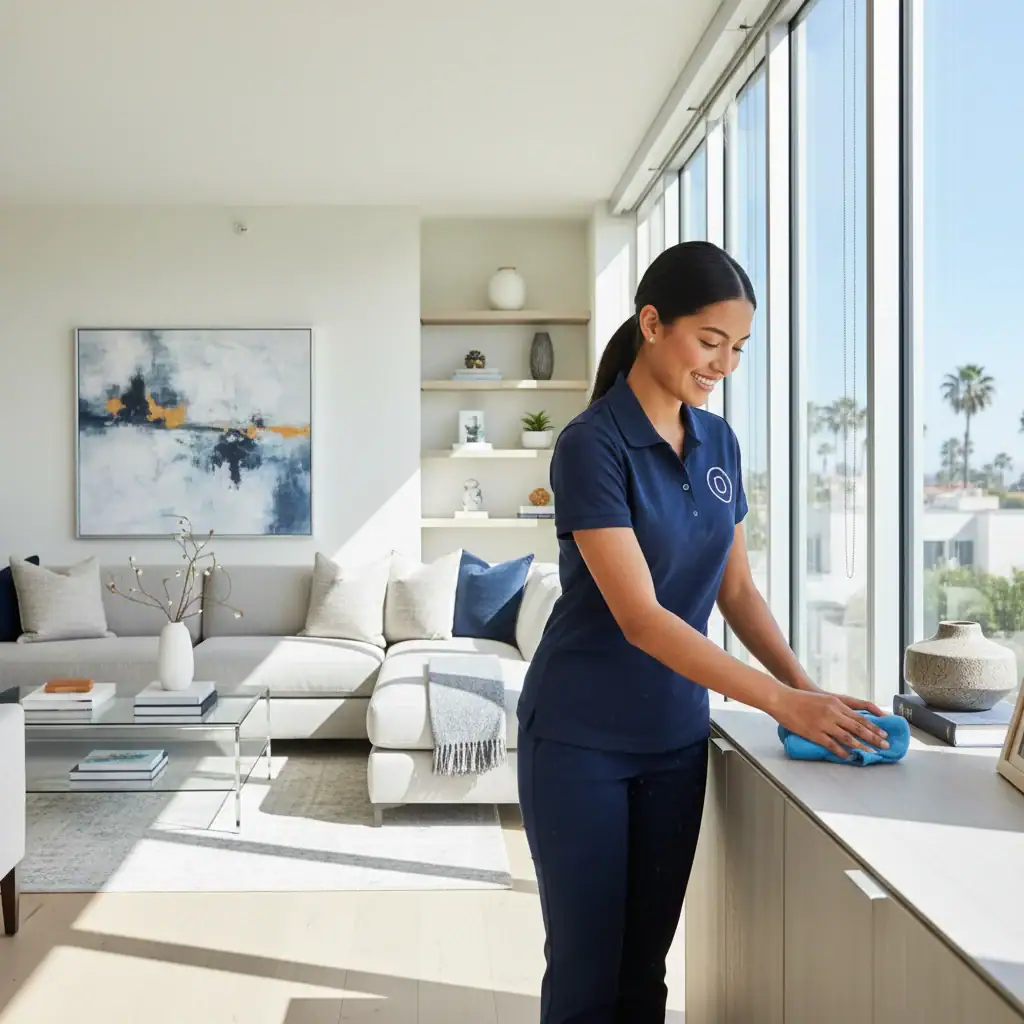

If you’ve ever handed back an apartment you thought was clean — only to lose a chunk of your deposit over a dirty oven or mineral buildup on the shower glass — you already know the gap between “looks clean” and “passes inspection.” That gap is exactly what a deep clean is meant to close. Not a quick wipe-down before the landlord shows up. A real, room-by-room reset that covers the things a regular cleaning never touches. This guide covers what that actually looks like, why San Diego County apartments come with a few specific challenges most guides ignore, and how to decide whether to tackle it yourself or bring in a professional.
What a Deep Clean Actually Covers — and How It’s Different From a Regular Clean
A standard cleaning hits the surfaces you see every week — counters, floors, the visible parts of the toilet. A deep clean goes further. It’s the inside of the oven, the grout lines in the shower, the top of the refrigerator, the baseboards, the window tracks, the exhaust fan in the bathroom. Areas that accumulate buildup over months and don’t get touched in routine maintenance.
The scope matters because landlords know exactly where to look. Most move-out inspections focus on the kitchen and bathrooms — the two rooms where buildup is hardest to fake your way through. A surface-level clean might look fine at a glance, but mineral deposits on the shower door or grease behind the stovetop will show up under scrutiny. Understanding what a deep clean actually covers is the first step to doing it right.
Room-by-Room: What Bathroom Deep Cleaning Actually Requires
The bathroom is usually the hardest room to deep clean in a San Diego County apartment — and not just because it’s unpleasant work. San Diego County’s water supply is naturally high in mineral content. That means calcium and limescale deposits build up on shower glass, faucet heads, sink basins, and tile grout throughout the county, from Chula Vista to Clairemont to Escondido.
A standard glass cleaner won’t touch mineral buildup. You need a descaling agent and some patience, or a professional who knows the difference.
Start at the top and work down. Clean the exhaust fan — pull the cover off and get the dust out of it. Wipe down the light fixture. Then move to the shower: scrub the grout, treat the glass or tile for mineral buildup, clean the showerhead, and get into the corners. The toilet needs more than a bowl brush — clean behind it, around the base, and under the rim. Open the cabinet under the sink and wipe it out. Baseboards last, because dust falls as you work.
What most people miss: the caulk lines around the tub and shower base. Mold and mildew settle into caulk, and it’s one of the first things a property manager checks. If it’s discolored, no amount of scrubbing will fix it — it needs to be replaced. For coastal properties in areas like Pacific Beach, Ocean Beach, or Coronado, salt air and humidity make this problem worse and faster. Renters in those neighborhoods tend to see mildew develop more quickly than those living inland, which means bathroom deep cleaning needs to happen more often — and more thoroughly — to stay ahead of it.
Kitchen Cleaning Services: What a Real Deep Clean Covers in the Kitchen
The kitchen is the other room that makes or breaks a move-out inspection. And it’s the room where most DIY deep cleans fall short — not because people aren’t trying, but because some of the buildup requires time, the right products, and knowing where to look.
Inside the oven is the obvious one. Baked-on grease doesn’t respond to a quick spray and wipe. It needs a proper degreaser, time to soak, and real scrubbing. Same goes for the stovetop burners and the drip pans underneath them. The range hood filter — the one above the stove — is something renters almost never clean, and landlords almost always check. Pull it out, soak it, and clean it properly.
The refrigerator needs to be emptied and cleaned inside: shelves, drawers, the rubber seal around the door, and the space underneath if it can be moved. The microwave interior, the dishwasher filter, the garbage disposal — all of it matters. Cabinet fronts accumulate grease and fingerprints over time, and cabinet interiors should be wiped out completely. The backsplash behind the stove is another spot that gets overlooked in regular cleaning and shows up immediately in an inspection.
One thing worth knowing: the sink area in San Diego County kitchens tends to show hard water deposits around the faucet base and in the basin — the same mineral buildup issue that affects bathrooms. A standard dish soap won’t remove it. If you’re preparing for a move-out, budget extra time for the sink, or flag it specifically if you’re hiring a professional cleaning service.
San Diego County Renters and Security Deposits: Why the Stakes Just Got Higher
California’s AB12 law took effect on July 1, 2024, and it changed something important for renters across the state. Most residential landlords are now capped at collecting one month’s rent as a security deposit. In San Diego County, where average rent sits around $2,170 per month, that deposit represents real money — and cleaning disputes are the most common reason landlords withhold it.
The math is straightforward. If a professional deep clean costs a few hundred dollars and a cleaning dispute costs you $500, $800, or more of your deposit, the calculation isn’t complicated. The question is whether the clean you do — DIY or professional — actually meets the standard a property manager expects.
How Often Should You Deep Clean Your Apartment?
Move-out is the obvious trigger, but it’s not the only one. Most households benefit from a deep clean every three to six months, and more often if there are pets, children, or anyone with allergies in the home. In San Diego County, the combination of coastal humidity in beach neighborhoods and dry inland dust in areas like El Cajon, Santee, and Escondido means that buildup happens at different rates depending on where you live — but it happens everywhere.
Move-in cleaning is just as important as move-out, and it’s something renters often skip. You don’t know how the previous tenant cleaned — or didn’t. Starting fresh in a professionally cleaned apartment means you’re not inheriting someone else’s grease, mildew, or hard water deposits. It also gives you a documented baseline if there are ever questions about the unit’s condition when you leave.
Beyond moving, there are other moments when a deep clean makes sense: after a renovation or repair project, after a long stretch of illness in the household, before hosting a significant gathering, or simply when the apartment has gotten away from you and a regular clean isn’t going to cut it. San Diego County’s military community has its own version of this timeline — PCS orders can move a family on short notice, and a move-out clean that meets base housing standards is a specific and non-negotiable requirement.
Housekeeping Services After a Deep Clean: How to Keep Your Apartment There
A deep clean resets your apartment. Regular housekeeping keeps it there. The two aren’t competing options — they work together. Once the grout is clean, the oven is scrubbed, and the hard water deposits are gone, maintaining that standard is significantly easier and less time-consuming than getting there in the first place.
For renters who want to stay ahead of the buildup — and avoid needing another full deep clean before move-out — recurring housekeeping is the practical answer. We offer recurring rates starting at $50 per hour for monthly visits and $45 per hour for weekly or bi-weekly service. That’s meaningfully less than a one-time deep clean, and it keeps your apartment in a condition where a move-out clean is a finishing touch rather than a major project.
Here’s what recurring service actually looks like in practice: we show up on time, fully equipped — you don’t need to supply anything. A supervisor checks in during cleanings to make sure the work meets the standard we’ve committed to. If something isn’t right, we’ll return within 24 hours to fix it at no charge.
For renters across San Diego County — from Chula Vista to La Jolla, Coronado to Carlsbad — we can usually get you scheduled within a week. We use non-toxic, biodegradable products that are safe for kids, pets, and the environment — because a clean apartment shouldn’t come at the cost of the air quality inside it. For first-time customers, we offer an initial cleaning discount to make it easier to get started.
Ready to Deep Clean Your San Diego County Apartment? Here’s Where to Start
A real deep clean is more than a long afternoon with a mop. It’s the inside of your appliances, the grout in your shower, the mineral deposits on your faucets, and the spots your landlord will check before they decide how much of your deposit to return. In San Diego County, those challenges are specific — hard water, salt air, and a security deposit law that makes every dollar of a deduction more painful than it used to be.
If you’re ready to do it yourself, this guide gives you the framework. If you’d rather hand it off to someone who does this every day, Comforts Cleaning Services serves renters and homeowners across San Diego County — from Chula Vista to Carlsbad, La Jolla to El Cajon. We’re fully bonded, insured, and BBB accredited, and we bring everything we need. Reach out to get on the schedule — we’re usually available within a week.