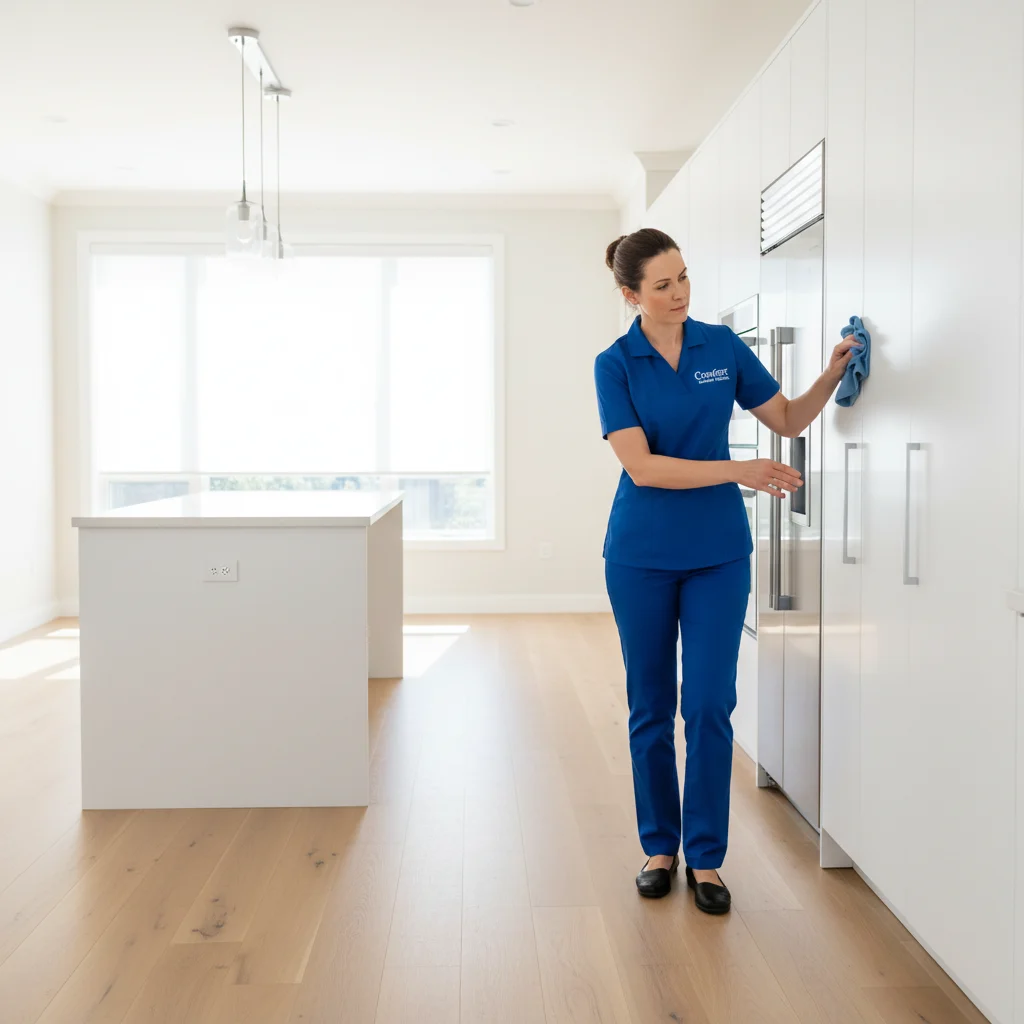
Most business owners in San Diego County don’t spend a lot of time thinking about their commercial floor cleaning contract — until something goes wrong. The crew doesn’t show up before a client visit. The invoice is identical to last month’s even though half the office is now empty. Or the floors still look the same after every cleaning and nobody can explain why.
The contract is usually where the problem starts. Not because cleaning companies are dishonest by default, but because most contracts are vague enough to leave real room for interpretation — and that ambiguity almost always benefits the provider. This post is about closing that gap. Here’s what you should actually expect, what you should ask for, and how to tell whether a contract is written in your favor or theirs.
What Does a Commercial Contract Cleaning Agreement Actually Include?
A commercial contract cleaning agreement is a recurring service arrangement where a cleaning company commits to a defined scope of work on a set schedule — weekly, bi-weekly, monthly — in exchange for a predictable rate. The key word there is “defined.” A contract that doesn’t specify exactly what gets cleaned, how often, and by what standard isn’t really protecting you at all.
At minimum, a solid commercial cleaning contract should spell out which areas are covered, what tasks are performed in each area, how frequently each task happens, and what the escalation process looks like when something isn’t done right. If any of those elements are missing or vague, you’re essentially paying for whatever the crew decides to do that day.
What Should a Commercial Cleaning Scope of Work Cover?
The Scope of Work — sometimes called an SOW — is the most important document in any commercial cleaning relationship. It’s the line-by-line breakdown of what the crew is responsible for every visit. Think of it as the difference between “we clean your office” and “we vacuum all carpeted areas, mop all hard-surface floors, wipe down all desks and countertops, clean and sanitize both restrooms, empty all trash receptacles, and clean the interior of the breakroom microwave every Tuesday and Friday.”
One of the most consistent problems in commercial cleaning is that providers quote based on a walkthrough — or worse, based on square footage alone — and then deliver a contract that’s light on specifics. The crew does what they can in the time they have, and the client has no real benchmark to measure against. This is how a business ends up paying for a full cleaning and getting a partial one, month after month, without any way to prove the discrepancy.
There’s a real-world example that illustrates this well: one audited corporate account was being billed for floor stripping services in areas that had been converted to carpet years earlier. The billing never changed. The invoice looked identical every month. Nobody caught it for years, and by the time someone did, the error had cost the business over $4,700. That’s not an extreme case — it’s what happens when scope isn’t reviewed and invoices aren’t questioned.
A thorough SOW should also cover what’s explicitly excluded. If we don’t do window cleaning, exterior work, or trash hauling, that should be written down. Knowing what’s not included is just as important as knowing what is, especially when you’re comparing bids from multiple companies. A lower bid that excludes three line items isn’t actually lower — it’s just incomplete.
When you’re reviewing a contract, ask the provider to walk you through the SOW room by room. If they can’t do that, or if the document is too generic to support that kind of review, that tells you something about how they operate.
How Pricing Models Work — and What the Numbers Actually Mean
Commercial floor cleaning is priced in a few different ways depending on the provider and the scope of work. The most common models are hourly, per square foot, and flat monthly rate. Each has trade-offs, and understanding them helps you compare bids without getting misled by the lowest number.
Hourly pricing is the most transparent model. You pay for the time actually worked, typically per cleaner per hour. National rates for commercial cleaning run between $30 and $75 per hour per worker, with the range depending heavily on the market, the type of facility, and whether the company is using W-2 employees or subcontractors. In San Diego County, rates on the higher end of that range are common for quality providers — the cost of living here is real, and companies paying their staff fairly tend to charge accordingly.
Per-square-foot pricing is common for larger commercial spaces. Industry benchmarks run from $0.07 to $0.25 per square foot for standard recurring service, with higher rates for healthcare, food service, or spaces with compliance requirements. A 10,000 square foot office cleaned three times a week typically runs somewhere between $1,200 and $1,800 per month. If a bid comes in dramatically below that range, the next question should be what’s not included.
Flat monthly rates can work well once the scope is clearly defined and both parties understand what’s covered. The risk is that a flat rate creates no incentive for the provider to adjust when your space changes — and without a periodic scope review, you can end up paying for services you’re not receiving, or not receiving services you assumed were covered.
At Comforts Cleaning Services, our pricing is published and straightforward. Standard service starts at $55 per hour per cleaner, with a three-hour minimum. Clients on a monthly recurring schedule pay $50 per hour, and clients who commit to weekly or bi-weekly service pay $45 per hour. The discount exists because consistency benefits both sides — we can plan our schedule, and you get a reliable crew that knows your space. There are no hidden fees, and our pricing page includes a plain-language disclaimer explaining why final costs may vary based on an on-site walkthrough. That kind of transparency isn’t standard in this industry. It should be.
How to Compare Contract Cleaning Companies Without Getting Burned
When you’re getting multiple bids for commercial floor cleaning, the instinct is to compare the monthly number and go with the lowest one. That instinct makes sense on paper, but it ignores everything that actually determines whether the service delivers value — scope, accountability, crew consistency, and what happens when something goes wrong.
The bid is just the starting point. The contract is where the real comparison happens. And most buyers never read it closely enough to catch the differences that matter.
Red Flags to Watch for Before You Sign a Commercial Cleaning Contract
A few patterns show up repeatedly in commercial cleaning contracts that end up costing businesses more than expected. None of them are hidden in fine print — they’re usually right there in plain language, just easy to overlook when you’re focused on the monthly rate.
The first is vague task language. Phrases like “general cleaning of common areas” or “floors maintained as needed” give the provider enormous latitude to define what counts as done. A legitimate contract names every area and every task. If a provider won’t give you that level of detail before you sign, they’re unlikely to deliver it after.
The second is auto-renewal without notice. Many commercial cleaning contracts include clauses that automatically renew for another term — sometimes a full year — unless you cancel within a specific window, often 30 to 60 days before the renewal date. If you miss that window, you’re locked in. Ask directly: what are the cancellation terms, and how much notice do you need?
The third is the subcontractor question. In California, this matters more than it does in most states. Under AB5, worker classification is strictly regulated, and a cleaning company that staffs your building with 1099 subcontractors rather than W-2 employees is operating in legally murky territory. More practically, subcontracted crews have no consistent training, no accountability to the company, and no reason to stay. Industry data puts average commercial cleaning employee turnover at around 150% annually — meaning the typical company replaces its entire workforce one and a half times per year. If a provider can’t tell you whether their cleaners are employees or contractors, that’s worth knowing before you hand over access to your building.
A fourth flag: a vendor who quotes without doing a walkthrough. Square footage alone doesn’t tell the full story of a commercial space. A provider who puts a number on paper without seeing the space is either guessing or using a template that doesn’t account for your specific conditions. That number will change — usually after you’ve already signed.
What Contract Cleaning Services Should Look Like in Practice — San Diego County Specifics
San Diego County has some specific conditions that affect what commercial floor cleaning actually involves day to day. Businesses near the coast — in La Jolla, Coronado, Imperial Beach, or Ocean Beach — deal with salt air, sand, and humidity that accelerate floor wear in ways that inland facilities don’t. A provider who understands that isn’t going to treat a beachside retail space the same way they’d treat an office suite in Mission Valley. Local knowledge matters.
The county’s economy also shapes the demand side of this equation. San Diego County has a high concentration of biotech and life sciences companies — particularly in the Torrey Pines and Sorrento Valley corridors — along with military installations, healthcare facilities, and a dense layer of small professional service businesses. Each of those environments has different cleaning requirements, different compliance expectations, and different tolerances for disruption during business hours.
A commercial cleaning contract that works for a dental office in Chula Vista isn’t the same as one that works for a restaurant in the Gaslamp Quarter or a medical suite in Carlsbad. In practice, a well-run contract cleaning arrangement in San Diego County should include a pre-service walkthrough before any agreement is signed, a written SOW that reflects what was discussed during that walkthrough, a defined quality assurance process (not just the crew self-reporting completion), and a clear satisfaction guarantee with a specific resolution timeline.
At Comforts Cleaning Services, we offer a 24-hour satisfaction guarantee — if something wasn’t done to your expectations, we come back and make it right within 24 hours. We also have supervisors who check in during cleanings, not just after, which means issues get caught before they become a pattern. We serve more than 20 neighborhoods across San Diego County, and we’ve worked in enough different types of commercial spaces to know that one-size-fits-all contracts don’t hold up.
The businesses we work with best are the ones who want a provider that actually understands their space — not one that sends whoever’s available and hopes for the best. Our team brings all supplies and equipment, uses eco-friendly, non-toxic, biodegradable products that are safe for employees and clients, and can schedule around your business hours, including after-hours service when daytime cleaning isn’t practical. California’s eco-conscious culture is especially strong in San Diego County, and we’ve found that more and more business owners here — particularly in professional services, healthcare-adjacent, and food-adjacent environments — are specifically asking about what products are being used and whether they’re safe for people with sensitivities. That’s a fair question, and we’re glad to answer it clearly.
How to Choose a Commercial Floor Cleaning Company You Can Actually Trust
The short version: read the contract before the price. A transparent scope of work, a clear cancellation policy, W-2 employees rather than subcontractors, and a provider willing to do a walkthrough before quoting are the markers of a company that takes the work seriously. The monthly rate matters, but it’s not the whole picture.
If your current arrangement isn’t delivering what you expected — or if you’re evaluating options for the first time — the most useful thing you can do is ask for specifics. What exactly is included? Who is doing the work? What happens if something isn’t done right? A provider who can answer those questions directly, without hesitation, is worth talking to further.
Comforts Cleaning Services is available to walk through your space, give you a straight answer on pricing, and put it all in writing before you commit to anything. Reach out today to discuss your San Diego County commercial cleaning needs.