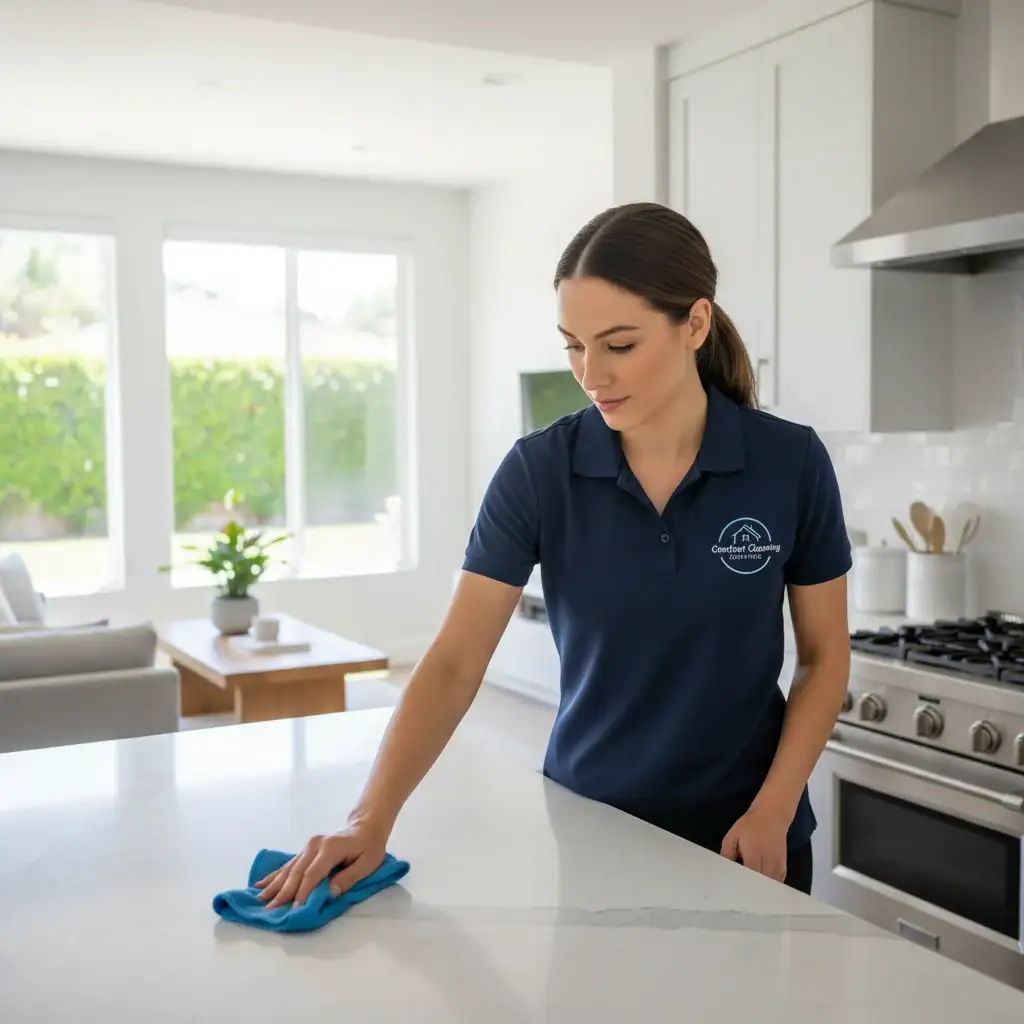
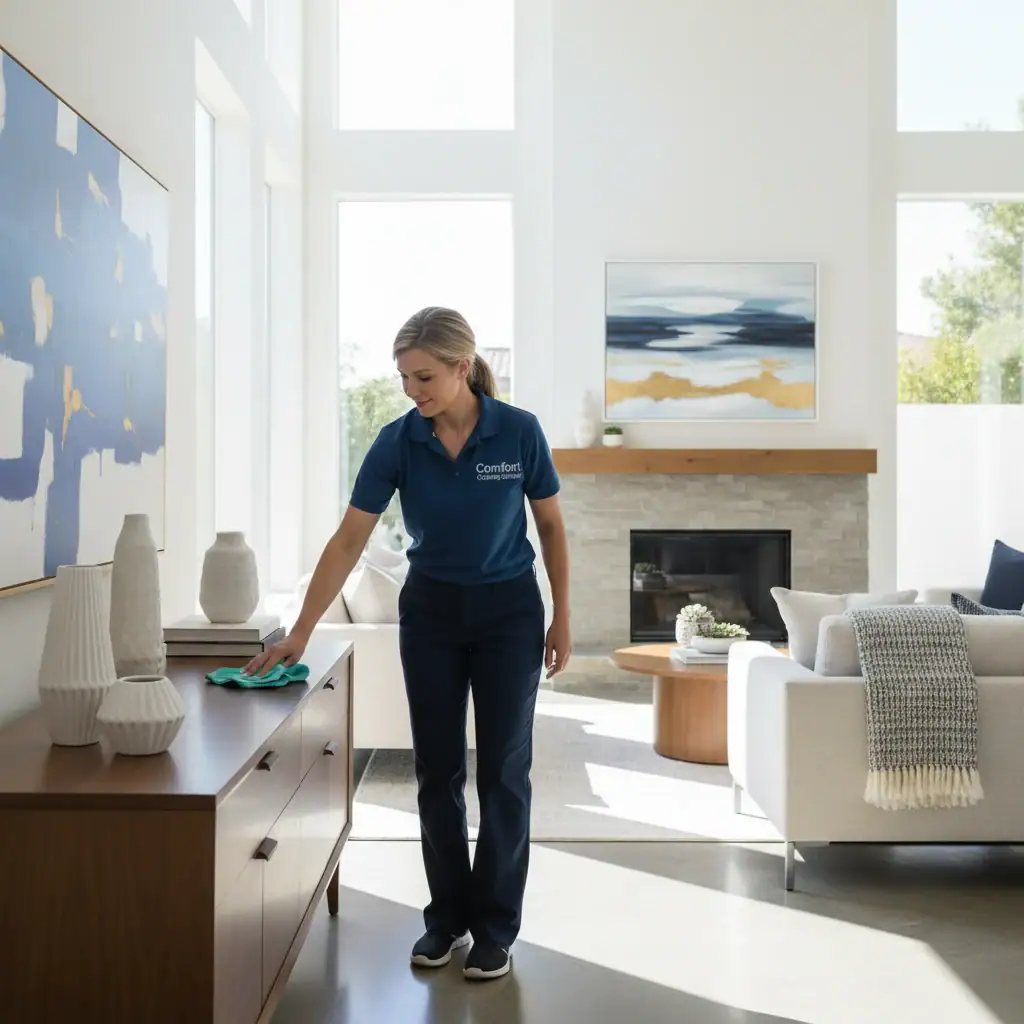
You finished the renovation. The contractors packed up, the new tile looks great, and you’re ready to move back in. Then you look around and realize the dust is everywhere — on the countertops you haven’t even used yet, inside the cabinets, along the window tracks, coating the floors. So you start cleaning. And a day later, it’s back.
This isn’t bad luck. It’s a sequencing problem. Post-construction dust behaves differently than everyday dust, and if you clean surfaces in the wrong order — or skip one particular step — you end up doing the whole job twice. Here’s what’s actually going on, and how to fix it.
The Right Way to Clean Construction Dust: Start at the Top
The best way to clean construction dust isn’t about which product you use — it’s about the order you work in. Start at the top of the room and move down. Ceilings, light fixtures, and upper shelves first. Walls next. Then countertops, baseboards, and finally floors. If you reverse that sequence even slightly, dust from higher surfaces falls onto areas you’ve already cleaned, and you’re starting over.
Before any wiping begins, ventilate the space. Open windows, run fans toward the exits, and let airborne particles move out rather than settle back down. Then vacuum everything — and it has to be a HEPA-filter vacuum, not a standard shop vac. Standard vacuums pull fine particles in and push them straight back out through the exhaust. Construction dust includes particles as small as 1 to 10 microns, invisible to the eye, and a regular filter won’t hold them.
Why Construction Dust Keeps Coming Back After You Clean It
If you’ve cleaned a post-renovation space and found it dusty again the next morning, the HVAC system is almost always the reason. Construction dust migrates into ductwork during a project. Once the system kicks on, it circulates that dust through every room in the house — including the ones you just cleaned. This can go on for weeks if the vents aren’t addressed.
The fix is straightforward but easy to skip: seal your HVAC vents before you start cleaning, so dust doesn’t enter the system during the process. When you’re done, replace the filters entirely. Standard HVAC filters aren’t rated to capture fine construction particulates, so even a filter that looks clean may be letting material through.
There’s another reason dust seems to reappear: the 24 to 48 hour resettlement window. Fine particles from drywall sanding, concrete cutting, and joint compound work don’t all fall at once. They stay suspended in the air for days. If you clean too soon after the last tool leaves the site, you’re only capturing the first wave. The particles still floating will settle after you’re done and coat everything again. Waiting a day or two before the final clean — and ideally running a HEPA air purifier in the space during that window — makes the difference between one thorough pass and three frustrating ones.
The other mistake that causes rework is mopping before vacuuming. Fine dust mixed with water doesn’t wipe up — it turns into a thin paste that smears across new flooring and dries into a haze. Vacuum everything dry first. Then damp-wipe with microfiber cloths. Dry dusting with a feather duster or cloth is also a problem — it just moves particles into the air rather than capturing them. Microfiber, slightly dampened, is what actually holds the dust and removes it from the surface.
None of this is complicated in theory. But in practice, it means doing things in a specific order, with specific tools, and with enough patience to let the dust fully settle before you call the job done. That’s where most DIY attempts fall short — not because of the effort, but because of the sequence.
What’s Actually in Construction Dust (and Why It’s Not Just Dirt)
Most people treat construction dust like it’s the same thing as regular household dust — just more of it. It isn’t. Drywall joint compound contains gypsum, talc, calcite, mica, and crystalline silica. Concrete dust carries silica as well. Silica is the one that matters most from a health standpoint: it’s a regulated substance under OSHA’s construction standards, and when inhaled over time, it’s linked to silicosis, an incurable lung disease, as well as lung cancer and COPD. NIOSH research found that drywall sanders can be exposed to dust levels up to ten times OSHA’s permissible exposure limit during active work.
That’s during construction. The cleanup phase is different — you’re not sanding — but the settled dust is still the same material, and disturbing it dry (by sweeping or using a leaf blower, for example) sends it airborne again. This is why dry sweeping is one of the most common mistakes people make. It feels productive. It moves the dust around. But it puts it back into the air rather than removing it, and fine silica particles stay suspended for a long time.
For older homes across San Diego County — neighborhoods like North Park, Kensington, or parts of Chula Vista, El Cajon, and Carlsbad with housing stock from the 1950s through the 1980s — there’s an additional consideration. Renovations in these homes can disturb older joint compounds that may contain asbestos, or walls with lead paint. If your project involved significant demo work in a home built before 1980, that’s worth knowing before you start cleaning without any protective equipment.
The point isn’t to alarm anyone — it’s to reframe the job. Post-construction cleanup isn’t a bigger version of your regular Saturday cleaning routine. It requires different tools, a specific sequence, and an understanding of what you’re actually dealing with.
Construction Site Clean Up: When to DIY and When to Call a Professional
For smaller projects — a bathroom refresh, new flooring in one room, cabinet replacement — a careful DIY cleanup with a HEPA vacuum, microfiber cloths, and some patience is reasonable. The steps are manageable if you follow the right sequence and give the dust time to settle before you start.
For larger renovations, full kitchen remodels, ADU builds, or anything that involved significant drywall work or concrete cutting across multiple rooms, the math changes. The sheer volume of fine particulate is different. The time required is different. And the consequences of getting the sequence wrong — or missing the HVAC step — are felt across the whole house, not just one room.
How Long Does Post-Construction Cleaning Actually Take?
The honest answer: longer than most people expect. A rough industry estimate puts post-construction cleaning at about one hour of work per 100 to 200 square feet. For a 2,000 square foot home, that’s 10 to 20 person-hours of actual cleaning time — not counting the 24 to 48 hour wait period between the initial rough clean and the final detail pass.
A two-to-four-person professional crew will typically spend 8 to 12 hours on a full-size home, and that’s with the right equipment and an established workflow. For someone doing it alone on a weekend with a standard vacuum and a roll of paper towels, the same job can stretch across multiple days and still not reach the same result.
This matters for a practical reason: most people scheduling a post-renovation clean are also trying to move back in, get a rental unit ready, or hand a space off to someone. Time pressure and thoroughness don’t always go together when you’re doing it yourself. A professional crew that can mobilize quickly and work through the job in a single visit — rather than dragging it across a week of evenings — is often the more realistic option, even for people who are comfortable doing their own cleaning otherwise.
San Diego County’s renovation pace makes this especially relevant. ADU permits in the county tripled between 2020 and 2024, from around 1,150 to nearly 4,000 per year. Home remodeling permits rose another 16% in 2025. A lot of homeowners across Chula Vista, El Cajon, Carlsbad, and La Jolla are finishing projects right now and facing exactly this situation — a space that’s done but not livable yet, and a timeline that doesn’t leave room for three attempts at cleanup.
Does Post-Construction Cleaning Require Harsh Chemicals?
This is one of the more common questions we hear, and the short answer is no. Post-construction cleaning is primarily a mechanical job — the right equipment and the right sequence matter far more than the strength of the cleaning products. HEPA vacuuming removes the bulk of the material. Damp microfiber cloths pick up what’s left on surfaces. For most construction residue, a mild, non-toxic cleaner is not only sufficient — it’s the better choice.
Harsh chemical cleaners can damage new finishes. Fresh grout, new paint, uncoated hardwood, and quartz countertops are all vulnerable to aggressive products, especially in the first weeks after installation. Using the wrong cleaner on a surface you just paid to have installed is a frustrating and avoidable outcome.
This is why we use only eco-friendly, non-toxic products — not as an optional upgrade, but as the default. In a post-construction environment where surfaces are new and finishes are fresh, gentler products protect the work that was just done. For families moving back into a renovated home with kids or pets, it also means no chemical residue on the floors and surfaces they’ll be in contact with immediately.
In coastal San Diego County neighborhoods — Pacific Beach, Ocean Beach, Coronado, and Encinitas — there’s an added wrinkle worth knowing. The marine layer brings moisture that can cause fine construction dust to adhere more stubbornly to surfaces, particularly new glass, tile, and painted walls. Homes near the coast may need additional damp-wipe passes on windows and exterior-facing surfaces where the combination of dust and morning humidity has had time to set. It’s a small detail, but it’s the kind of thing that makes a difference between a surface that looks clean and one that actually is.
Getting Post-Construction Cleanup Right the First Time
The reason post-construction dust cleanup goes wrong so often isn’t effort — it’s sequence. Seal the vents before you start. Wait for the dust to settle. Work top to bottom. Use a HEPA vacuum before anything wet touches a surface. Replace the HVAC filters last. Skip any one of those steps and the job isn’t finished, even if it looks like it is.
For smaller projects, following that sequence carefully is entirely doable. For larger renovations — especially in San Diego County, where projects are bigger, finishes are expensive, and timelines are tight — having a crew that knows the process and shows up equipped to do it right in one visit is often the more practical call.
If you’re finishing a renovation in San Diego County and want to hand the cleanup off to someone who will get it right, we’re available and can typically schedule within a week. Reach out to Comforts Cleaning Services for a free estimate and we’ll take it from there.